Cookies on RT Promotions
We use some essential cookies to make this service work.
We’d also like to use analytics cookies so we can understand how you use the service and make improvements.

Artwork
To get the image or ‘look’ that you will want printed onto the promotional gift, you’ll need to supply a file, or email attachment that shows us the ‘look’ so that we can copy it accurately. Most commonly this will be a logo or company strapline, maybe with a few words of your own added.
Bleed
When printing onto an object (mostly paper), it’s common for there to be a run-off area. Your artwork is expected to fit within a given area, say 100mm x 250mm, but you will need to allow for an area bigger than this, usually 5%, so that the printers can print beyond the given area. This area is called a ‘bleed’.
Blind Embossed
Embossing is an old established technique for personalising leather, soft PU/plastic, and diaries, whereby a heavy metal die is moulded in the shape of your logo or message. It then strikes the material with sufficient force as to leave an impression of your logo. Embossing is commonly used with a gold or silver foil, which is left behind, thereby colouring the logo in a gold or silver colour. This method is called Foil Blocking, whereas blind embossing is done without any foil.
Carriage
The cost of transporting the product from the production line, to your chosen address. In the promotional gifts market in the UK, ‘Carriage’ is often NOT included in displayed pricing and will need to be added to the total costs.
Debossing
A close relative to ’embossing’ but with the reverse effect. Embossing pushes your logo/artwork into the material, whereas debossing leaves your logo/artwork raised.
Digital Printing
Produced using ink jet print machinery. The four base colours – cyan, magenta, yellow and black, are used in varying quantities to produce millions of different colours and shades. It is great for printing photos, four colour process images and more detailed and complex logos.
Dye Sublimation
Printing starts with films that contain dyes; these are placed on the material and heated up by the print head. This causes the pigments to leave the film and enter into the material where it cools and re-solidifies.
Engraving
A very intricate process which involves carving the logo or artwork onto the item, producing a permanent form of branding. In most cases engraving is performed by specialist computer guided laser engraving machinery
Epoxy Doming
These are usually self-adhesive printed labels which then have an epoxy dome cover made. The dome is made from polyurethane resin and is durable, tough and long lasting. The label and doming process is often used to achieve four colour process logos and can be more cost effective than other printing methods.
EPS Vectored
Print quality, colour separated artwork is required for any work involving screens, block or dies, and should be supplied in a digital format wherever possible. A business card or letterhead is generally not sufficient for artwork. Digital artwork should be Mac compatible and supplied by email, or on a CD. The document should be an editable EPS vector file, or an editable PDF vector file created in either Adobe Illustrator or Freehand with fonts converted to outlines. Photoshop EPS Bitmap, JPEG, TIFF or GIF files are not editable.
Foil Blocking
Similar to ‘blind embossing’ see above, or ‘debossing’. Foil Blocking leaves an imprint in the item, but the difference is that it can also add colour. to the impression. The colour is added by placing a colour foil between the dye and the product. The most popular colours to use are silver and gold.
Half Tones
A half tone is like a gradient of a solid colour. If you look at newspaper print close up, you will see its really made of lots of little dots, giving the illusion of greytones. Think of an apple that is pale green at one end, and gradually changes its shading to dark green at the other end. These are all a form of half tones, and they may cause problems with certain types or printing. Many print processes for promotional giveaways use processes called ‘screen printing’ or ‘pad printing’. Both of these processes can only use artwork with solid colours, so in the example above, the apple would have to be just one colour, not a gradient of colours.
Jacquard
This is a term commonly used with embroidery. When you are having your company logo embroidered, the artwork is first digitized so that the embroidery machines know how to lay down and build the embroidery up and onto the garment. Your logo will have been a flat two dimensional object, and embroidery effectively turns it into a three dimensional one. Having created the digital disc of your logo, it now needs to be tested and embroidered onto a test swatch. This is called the jacquard, and will be shown to you for approval, prior to production commencing on the full consignment of embroidered garments.
Jpeg
The true definition of this is ‘joint photographic experts group’, but lets not worry too much about that. It’s a simple artwork file, of the type you would get from a digital photograph. It’s usually not of a high enough standard for use within screen printing processes.
Litho Print
This is a method used to print text or artwork onto paper. The required image is etched onto a metal plate and then transferred to a rubber roller. The image is then taken from the roller and applied to the item.
Origination
The artwork you provide that will ultimately be printed onto the promotional product you have selected, has to be set-up so that the production machine can understand your artwork. This process varies from company to company, and basically involves the shop floor ‘tooling up’ for your job, prior to it coming on line. In the case of a diary, it will involve the creation of a blocking die to imprint your logo, in the example of a pen, it may involve a complicated process to create tiny little silk screens to squeeze the inks through and onto your pen. These charges are called ‘screen charges’, ‘set-ups’ or ‘origination’.
Overs and Unders
The process of mass-production involved on many promotional products often results in slight variations, both up and down, on the quantity ordered. This generally only happens on quantities of 1,000 units or more, and usually stays within a tolerance of 5%. You will only ever be charged for the quantity delivered, but if the EXACT quantity is important to you, please tell us in advance as we can often do something about it.
Pad Print
This is a technique commonly used for printing onto awkward or rounded shapes. It involves a ‘pad’ that when pressed against the surface being printed naturally wraps itself over it leaving a printed image behind.
Pantones
When arranging for your artwork to be printed onto a promotional gift like a pen, coffee mug or keyring, you will be asked what colour you want it printed in. These colours are often referred to as ‘pantones’, or sometimes ‘PMS’. These are established systems giving each specific colour an identity, referred to by a unique number, this is your pantone reference number. This ensures that your chosen colour, lets say ‘red’, will be exactly the same tone or shade of red, wherever and whenever you have it printed.
Pre-Production Sample
If you are really nervous that the job will look just right, you can always request ONE of the items you are having printed to go through the production process all on its own! It’s not common to do this, and is disruptive to the production line, so there is usually a hefty charge to have this done. The one-off item that you then receive, fully personalised, is called a ‘pre-production sample’.
Print Area
You may look at a pen, or a coffee mug, and think you can have your logo or artwork printed anywhere you like. The simple answer is you rarely can. There will be pre-determined areas where you can print, which are known as the print areas.
Proof
A very important part of the process when purchasing a promotional product. You have supplied the artwork. You have even seen a visual of how everyone thinks the pen will look with your logo on it, and the production team are ready to start work on your project. It’s now that you will be given a ‘pre-production proof’ or ‘proof’ of your artwork that’s about to be used. This is usually done by email and a pdf attachment that you will need to print out and read VERY carefully. This is your last chance to make sure that there are no spelling mistakes, that your telephone number or web address are correct, and that the colour that’s about to be printed is the right one. You will always be asked to sign your approval on this form, and only then, will production commence.
PVC
PVC (polyvinyl chloride) is a type of plastic which is easy to mould and can be produced in many colours. A bespoke mould is created incorporating a logo in various shapes and designs and is then filled with the liquid PVC and left to set and harden.
Registration
Look at a logo with more than one colour. The relationship between the 1st, 2nd, 3rd, etc colours is called ‘registration’. Do the colours touch? Is there a big gap between the colours or a small one? You’ll often hear this described as ‘tight’ registration.
When printing more than one colour onto an object, the most common process is that the first colour is printed and allowed to dry, and then the product needs to be processed again for the 2nd, 3rd, 4th colour. Given that these secondary colours need to align themselves accurately with the other colours, that can difficult if the ‘registration’ tight.
The promotional gift industry prints onto thousands of different shaped items, and so getting these colours to align properly (to register properly) is an art-form in its own right.
Rotary Engraving
The principle is much the same as a standard engraving but specialist machinery enables the item to be rolled as it is being marked, allowing the branding to cover the circumference of the item.
Rotary Printing
This is a type of screen printing in which the product is rolled along the screen so that the print covers the circumference of the product, creating a ‘wrap around’ print
Sample
These are examples of the item you are considering. They will be a current production example, but not necessarily in the colour you are considering purchasing, and they may even be ‘plain stock’, that is, they may not have any branding on them at all. They give you an opportunity to touch and feel, and perhaps even use the article you are considering personalising.
Screen-Charge
See ‘Origination’ above. It’s important to remember that screen charges will often be charged ‘per colour’ for every colour you want printed. So, if you are having a pen printed with your logo on it, and your logo has three colours, its likely you will be charged for three screens (one per colour used).
Screen Print
A sophisticated method of printing that places a material (silk screening is most popular) onto the item being printed, and then allows the inks to be squeezed through the material, leaving the image of your artwork behind.
Sign-Off
See ‘Proof’ above
Swatch
When you are having a product personalised by embroidery, rather than showing you a virtual printed visualisation of the garment at ‘proof’ stage, we will get an example of the embroidery, onto a piece of clothing, and show this to you as a ‘proof’. This type of proof is called a ‘swatch’.
Transfer Print
This is a process whereby the artwork is applied to a thermal paper which is then transferred to the item via a heat process. This personalisation technique is ideal for producing four colour process logos onto material based product. Often used as an alternative to screen printing, it’s difficult to tell the difference on the finished article, and is generally used for more complex artwork.

Some of our shoppers now have this GOTS certification, read our article to find out more

Some European markets are taking a hard line on bamboo and melamine plastic products. We explain what you need to know
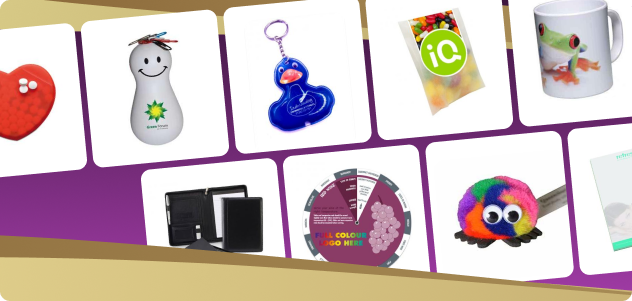
Promotional branded gifts can add massive value to your marketing message and create brand memories that are both engaging and impactful.
Shop all new products
If you’re from further afield, call or email us for friendly, unbiased advice about what promotional gift would work best for your campaign!
Contact Us